
Wedding Speech Timeline

Updated: Sep 29
Speeches are one of the few parts of a wedding reception that genuinely can't be redone. The first dance can be restaged if the timing's off. Cake cutting can wait five minutes. A speech happens once, live, in front of everyone, and whatever gets captured in that moment is what exists afterwards. That makes the running order around speeches worth more planning attention than most couples give it.
At a glance
Speech order varies by family and culture, but a common structure is a parent, best man, maid of honour, sometimes the couple.
Aim for roughly three to five minutes per speaker, longer speeches lose the room and make for a harder video edit.
Before mains, between courses, or after dessert each has real trade-offs, pick one deliberately with your MC.
Lighting and audio need to be sorted before the first speech starts, not adjusted live during it.
Typical speech order, and why it varies
There's no single correct order, and it genuinely does vary by family, culture and personal preference. That said, a common structure at Auckland receptions runs: a parent (usually the father of the bride, though this is shifting toward whichever parent the couple chooses), the best man, the maid of honour, and sometimes the couple themselves closing things out with a joint thank-you.
Cultural and family traditions can reshape this order significantly, and some of the site's dedicated cultural-wedding guides cover speech and toast customs specific to particular communities in more detail. The general order above is a starting point for a typical Western-style Auckland reception, not a rule. What matters more than the exact sequence is that everyone involved knows their slot in advance, nothing derails a speech segment faster than someone being unexpectedly called up with no warning.
How long is actually too long
Wedding-planning consensus generally lands somewhere around three to five minutes per speaker as the sweet spot, long enough to say something real, short enough that the room stays with you. Speeches that run well past that tend to lose the audience's attention partway through, and the energy is hard to fully recover once it drops.
There's a practical video consequence too, worth knowing in advance. A five-minute speech edits down cleanly into a highlight reel with a strong opening and closing line. A fifteen-minute speech, even a genuinely heartfelt one, usually has long stretches that don't hold up as tightly on video, meaning more gets cut, and the version that ends up in your final film is a smaller fraction of what was actually said. If a speaker's likely to run long, it's worth a gentle heads-up beforehand, not as a rule, just so they know the room (and the edit) rewards a tighter version.
Where speeches sit relative to the meal
This is a genuine trade-off, and there's no universally right answer, it depends on what you want to protect.
Speeches before mains mean guests are at their most attentive, nobody's mid-meal and distracted, but it does mean food can sit waiting in the kitchen if speeches run long, which affects the temperature and timing of the meal itself.
Speeches between courses (often after entrees, before mains, or between mains and dessert) break the meal into a more paced rhythm and give the kitchen a natural window, but they can create a slightly stop-start feel to the evening if there are several speakers spread across multiple breaks.
Speeches after dessert keep the meal moving without interruption and let guests properly relax into the food, but energy in the room is often already dipping toward the dancing by that point, and a heartfelt or lengthy speech can feel like it's competing with guests who are ready to be up and moving.
A five-minute speech edits down cleanly into a highlight reel with a strong opening and closing line. A fifteen-minute one usually has long stretches that don't hold up as tightly on video.
None of these is wrong. What matters is picking one deliberately, with your MC or celebrant, rather than letting it default to whatever the venue usually does.
The photographer and videographer's-eye case for sorting this in advance
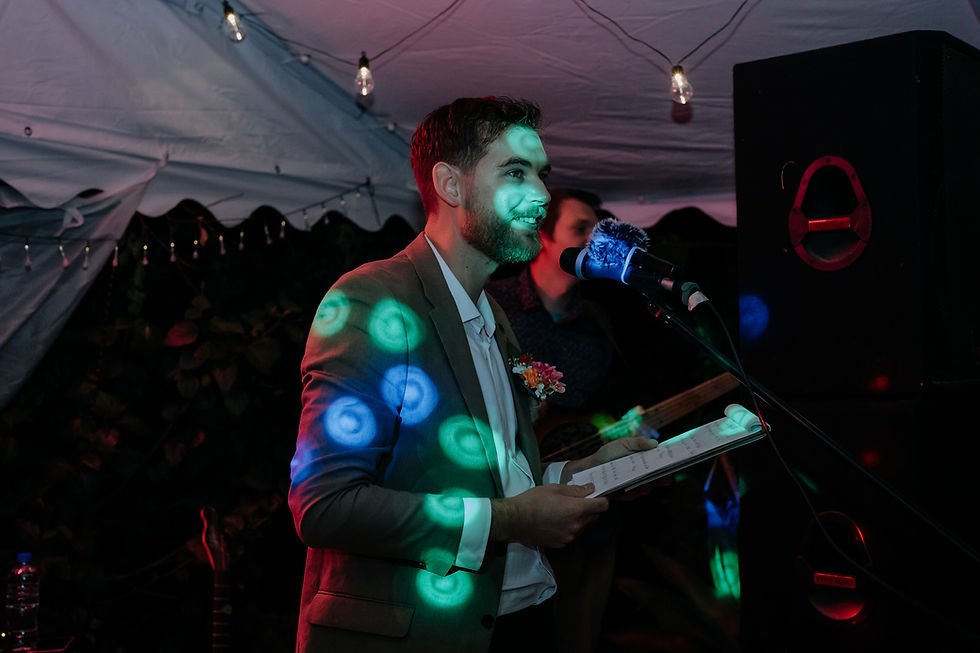
Here's the part that's easy to overlook: speeches are the single most unscripted, unrepeatable segment of the whole reception, and the lighting and audio setup for them needs to be right before the first person stands up, not adjusted on the fly once they're already speaking.
For photos, that means knowing where the speaker will actually stand (head table, a separate lectern, wandering with a handheld mic) so the room's lighting and the photographer's position can be worked out ahead of time, rather than guessed at when someone unexpectedly stands up from a different seat. For video, it means the microphone situation needs to be sorted before speeches start: a venue's house PA, a dedicated lapel or handheld mic, or the videographer's own audio setup, because there's no reshoot if a heartfelt line is lost to a mic that wasn't switched on.
This is exactly why it's worth flagging speeches specifically when discussing reception lighting with your venue and DJ, since even beautifully dim, atmospheric evening lighting can leave a speaker's face in shadow if nobody's thought about where they'll actually be standing.
Coordinating with your MC or celebrant
The single most useful thing a couple can do is get the running order and rough timing to their MC or celebrant well before the day, not as a formality but because it's the document everyone else, including your photographer and videographer, works from. Include the order of speakers, roughly how long each is expected to run, and where in the meal they'll happen. Share that same running order with your photography and videography team so they know exactly when to be ready, rather than reacting in real time to a segment of the day that only happens once.
It's also worth telling your MC which moments you actually want captured well. If there's a speech you know will run emotional, a parent's toast, a sibling standing in for someone who couldn't be there, flag it specifically. Your photographer and videographer will naturally prioritise coverage across the whole segment, but knowing in advance which speech carries the most weight for you means they can position themselves for the reaction shots around it too, not just the speaker. A room's genuine emotional reactions, a parent tearing up, the couple glancing at each other, are often the photos and footage couples end up valuing more than the speech itself.
None of this needs to be rigid. Speeches occasionally run over, someone gets pulled up unexpectedly, plans shift. But a shared running order means everyone, MC, celebrant, photographer and videographer, is working from the same expectations rather than improvising around each other. It's a small piece of planning that protects the part of your wedding video and photos you'll actually watch back the most.
Planning your own wedding?
Send us your speech order once it's set and we'll build it into your day's coverage, so nothing important gets missed while a camera's being repositioned.


Comments