
Russian and Ukrainian Wedding Traditions in New Zealand: What's Shared, and What's Not

Russia and Ukraine are two different countries with two distinct communities in New Zealand, and their wedding traditions deserve to be treated that way rather than folded into one generic "Slavic wedding" idea. Some customs genuinely are shared, a result of common Eastern Slavic and Orthodox Christian heritage stretching back centuries. Others belong specifically to one culture and shouldn't be assumed onto the other. This guide sets out both: what's shared, what's distinct, and how much of any of it depends on the individual family.
Before you read on
Russia and Ukraine are separate nations with separate communities. Where a custom below is shared by both, it's because of common Orthodox and Eastern Slavic heritage, not because the two cultures are interchangeable. Religious observance also varies genuinely by family and generation.
Bride ransom: Vykup nevesty, shared
Church ceremony: Orthodox, optional today
Korovai bread: Ukrainian-specific
Reception: Toastmaster-led
At a glance
Vykup nevesty (bride ransom) is a shared, lighthearted pre-ceremony custom across both cultures.
The Orthodox church ceremony (crowning, rings, walking around the analogion) is shared through common Byzantine liturgical roots, but not every family holds a full church wedding today.
Korovai, the elaborate ceremonial bread, is specifically Ukrainian, not a default Russian custom.
Both cultures commonly use a toastmaster to structure reception toasts, games and dancing throughout the evening.
Vykup nevesty: the bride ransom
Vykup nevesty, the "buying back" of the bride, is a lighthearted custom shared across Russian and Ukrainian tradition. On the wedding morning, the groom arrives at the bride's family home to collect her, but he doesn't just walk in. Family and friends block the way, demanding a "ransom," money, small gifts, sometimes a completed task or an answered riddle, before they'll let him through.
Some families add a playful twist: a decoy is presented first, a friend or relative under a veil, and the groom has to correctly identify that it isn't his actual bride before negotiations continue. The whole thing is performed as comedy rather than genuine obstruction, with the ransom demands escalating for effect before the bride is finally "released" to him. It's genuinely one of the more theatrical parts of the day, closer in spirit to a game the whole gathered family plays together than to a formal ritual.
It's performed as comedy rather than genuine obstruction, with the ransom demands escalating for effect before the bride is finally released to him.
The Orthodox church ceremony
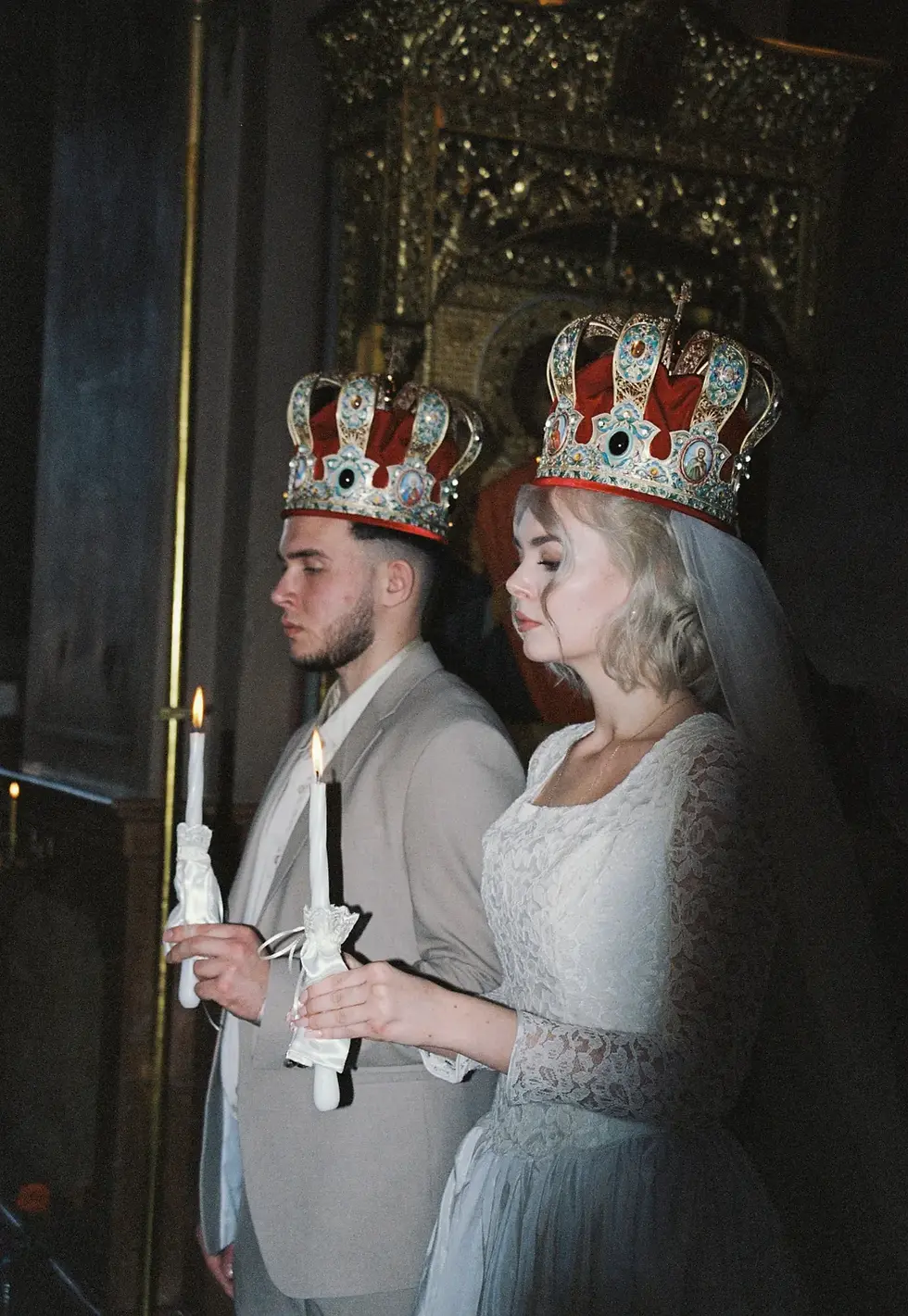
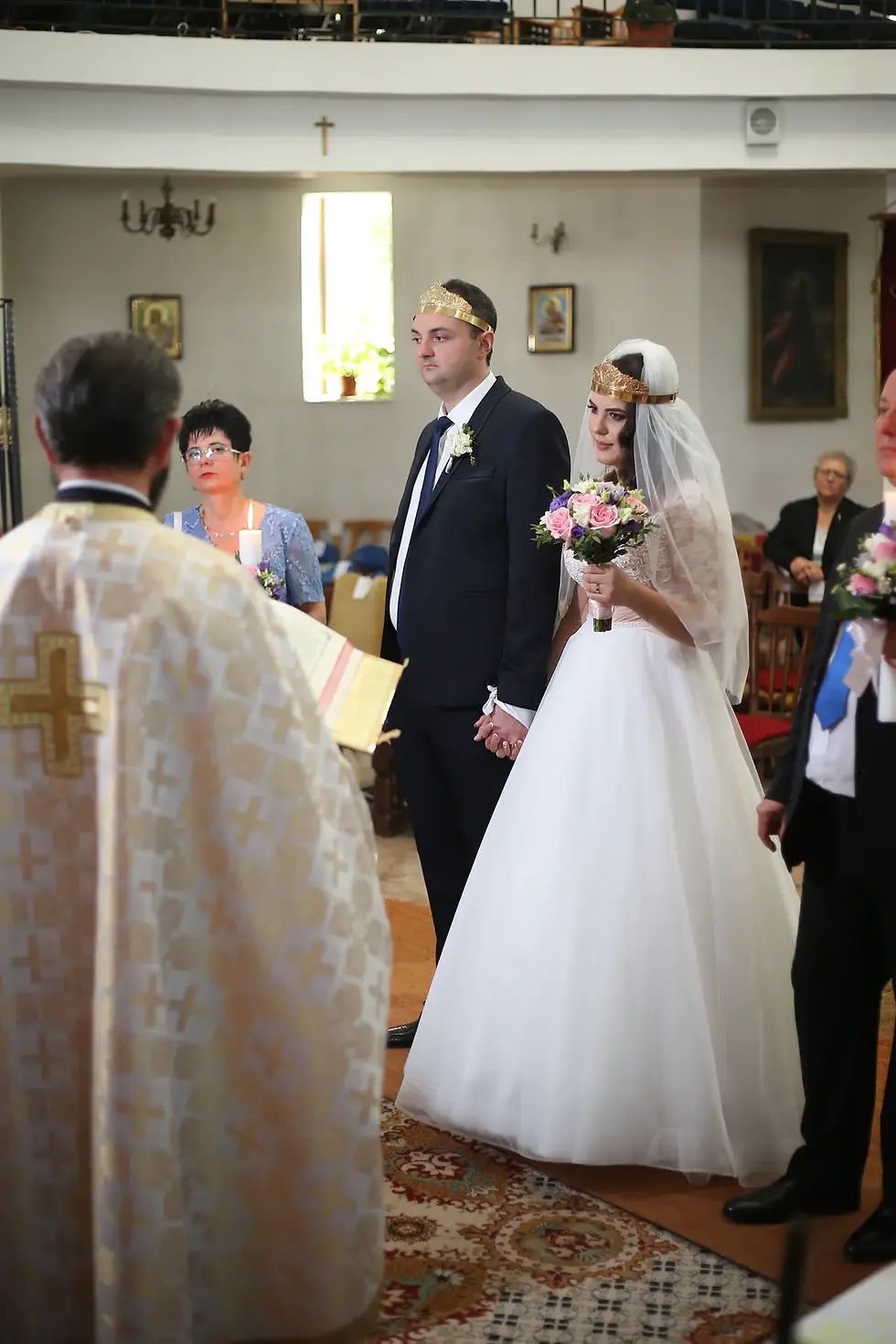
For families who marry in an Orthodox church, whether Russian Orthodox or Ukrainian Orthodox or Greek-Catholic, the ceremony follows a structure shared across Orthodox Christian tradition generally, since both draw on the same Byzantine liturgical roots. It happens in two parts.
Betrothal: The priest blesses the rings and exchanges them between the couple, traditionally three times, echoing the Trinity, before they're placed on the couple's right hands.
Crowning: The priest places crowns on the couple's heads, often switching them between bride and groom three times over the course of the rite.
The shared cup: The couple drinks wine from a common cup together, a symbol of their shared life ahead.
Around the analogion: The priest leads the couple three times around the analogion, the stand holding the Gospel book, sometimes called the Dance of Isaiah, their first walk together as a married pair.
It's worth being upfront that not every Russian or Ukrainian wedding in New Zealand includes a full church service like this. Religious observance varies by family and by generation, and a wedding that keeps the church ceremony in full is one real, common choice, not the only one.
Korovai: Ukraine's ceremonial wedding bread
Korovai belongs specifically to Ukrainian tradition, alongside related breads found in Belarusian and some Russian regional and Polish custom, and it shouldn't be assumed onto a Russian wedding as a default. It's a large, round, elaborately braided and decorated loaf, traditionally baked in the bride's home by a group of women, often an odd number, commonly seven, who sing traditional songs together as they work.
The finished loaf is blessed and presented to the couple before the ceremony, then shared among guests later as part of the celebration. Its decoration carries real symbolism: two small dough birds represent the bride and groom, other shapes stand in for family and friends, and a wreath of periwinkle around the edge represents love and purity. Exactly how it's decorated varies by region, but the loaf's central role, blessed, shared, genuinely built by hand rather than bought, stays consistent across the sources describing it.
The toastmaster-led reception
Both Russian and Ukrainian wedding receptions commonly run under the direction of a toastmaster, sometimes called a tamada, who structures the evening around a sequence of toasts rather than leaving it to chance. The first toast usually goes to the newlyweds, and it's traditional for guests to respond by calling out "Gorko" (meaning "bitter"), prompting the couple into an extended kiss said to "sweeten" the toast. A second toast typically follows for the parents, and the evening continues with further toasts, games, singing and dancing woven throughout rather than confined to one speech segment near the start.
This structure is genuinely different from a typical Auckland reception's speeches-then-dancing shape, since toasting, games and dancing tend to run together across the whole evening instead of being sequenced into separate blocks. A toastmaster who knows the family and the rhythm they want makes a real difference to how smoothly that plays out.
What genuinely varies by family and generation
None of this is a fixed script. How religious a family is, how many generations removed from Russia or Ukraine they are, and which specific traditions matter to them personally all shape which of these customs actually appear on the day, and how elaborately. Some families do the full church ceremony with crowning and the walk around the analogion. Others have a civil or celebrant-led ceremony in the New Zealand system and keep only the reception-side customs, the toastmaster, the toasts, maybe korovai if the family is Ukrainian. Some do vykup nevesty as a genuinely elaborate, planned-out performance with costumes and props; others keep it brief and informal.
Auckland has an organised Russian Orthodox church community, with roughly a fifth of New Zealand's Russian population associated with it, alongside an active Ukrainian community association and both Orthodox and Greek-Catholic church options for Ukrainian families. That means the option to hold a full traditional church ceremony locally genuinely exists, but it's one option among several real ones, not evidence that most families choose it.
What this means for planning your day
Because there's real variation here, the most useful thing a couple can do is tell their photographer and celebrant specifically which of these traditions they're keeping, rather than letting a vendor assume "a Russian wedding" or "a Ukrainian wedding" means one fixed format. If vykup nevesty is happening, it benefits from the same kind of advance planning as any other live, performative moment: knowing roughly when and where it'll happen, and who's involved, makes it far easier to cover well rather than catch by accident. If a full Orthodox ceremony is part of the day, the walk around the analogion is worth flagging specifically, since it's a genuine once-only moment that a photographer positioned in the wrong spot can easily miss the best angle on.
The reception's toastmaster-led structure is worth mentioning to a videographer or photographer too, since a long, movement-heavy evening with toasts and dancing interleaved throughout needs a different coverage plan than a shorter, front-loaded speeches segment.
Frequently asked questions
Are Russian and Ukrainian weddings basically the same?
No. They share real common ground through Orthodox Christian and Eastern Slavic heritage, vykup nevesty and the general ceremony structure among them, but korovai, for example, is specifically Ukrainian, and treating the two as interchangeable misses genuine differences.
Do all Russian and Ukrainian weddings in New Zealand include a full Orthodox church ceremony?
No. Religious observance varies by family and generation. A full church wedding is one real, common option, not a universal default.
What's the "Gorko" toast about?
It's a reception custom where guests call out "Gorko" (bitter) after a toast to the newlyweds, prompting them to kiss for as long as guests keep calling it out, said to "sweeten" the toast.
Planning your own wedding?
If you're keeping vykup nevesty, a full Orthodox ceremony or a toastmaster-led reception, tell us which and we'll build our coverage plan around them.


Comments